
Which Water Mains Should Utilities Inspect First?
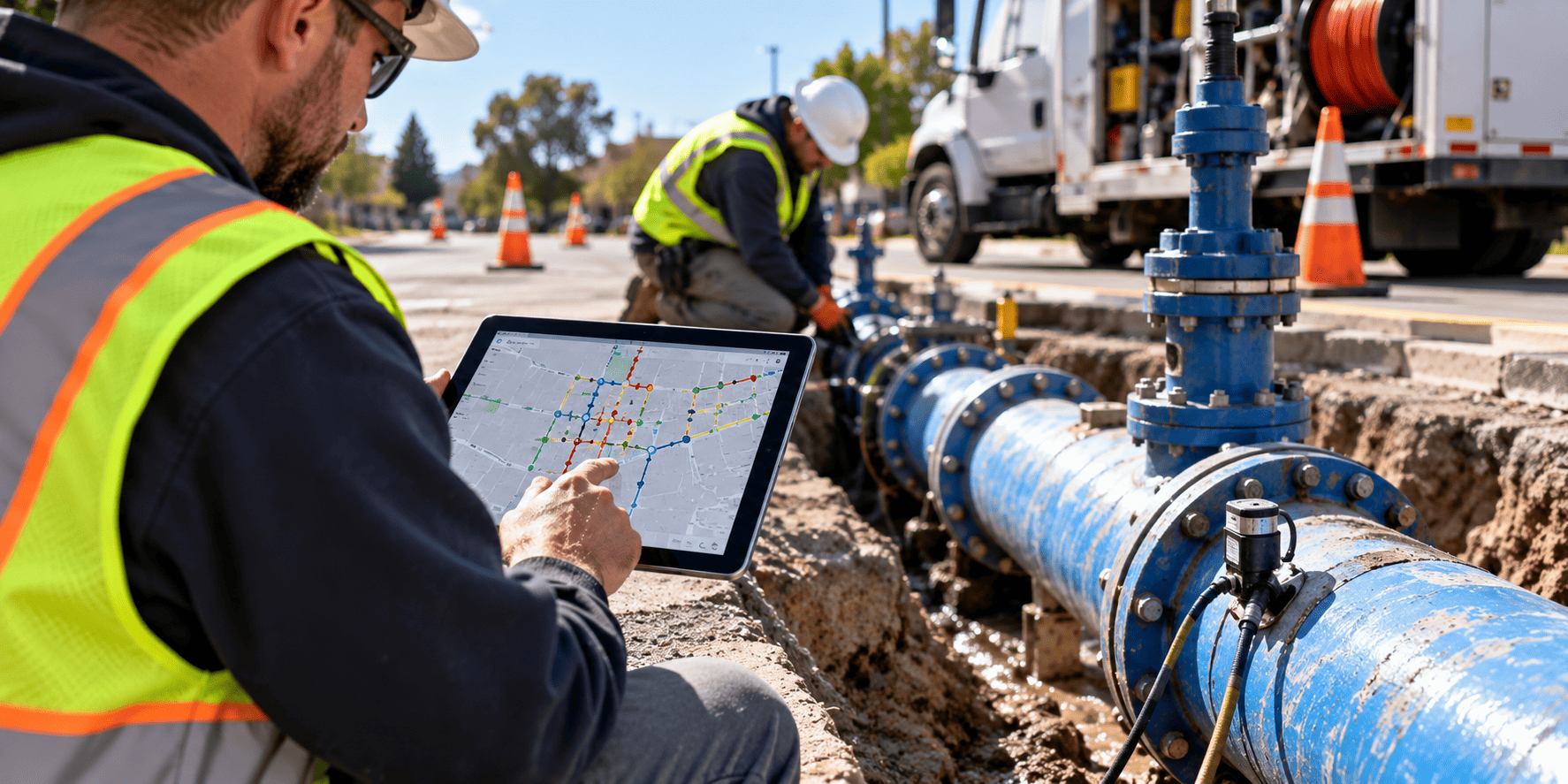
Water utilities may manage hundreds or thousands of miles of buried water mains, but inspecting every pipeline at the same level is rarely practical. Budgets, access, shutdown requirements, pipe materials, and inspection costs all make prioritization necessary.
The best approach is usually to inspect water mains based on risk, not age alone. Utilities should consider both the likelihood that a main could fail and the consequences if that failure occurs. A critical transmission main with uncertain condition and no alternate supply route may deserve inspection before an older distribution main with stable performance and good redundancy.
Why Utilities Cannot Treat Every Water Main The Same
Every water main carries a different combination of condition, operating stress, service importance, and failure consequences. Applying the same inspection strategy to every pipe can direct resources toward assets that present relatively little risk while more critical pipelines remain poorly understood.
Pipe diameter, material, installation year, break history, pressure, surrounding soil conditions, customer demand, and redundancy can all change the priority. Utilities should use these factors to screen the system before committing to detailed field inspection.
Existing operating problems also matter. Reduced flow, repeated leaks, sediment, pressure concerns, and discoloration may indicate conditions worth investigating. Understanding common water main problems can help utilities recognize where additional condition information may be valuable.
Start With Risk: Likelihood Of Failure × Consequence Of Failure
A practical water main inspection program begins with two questions:
How likely is this main to fail?
What happens if it does?
Combining likelihood of failure with consequence of failure helps utilities identify the pipelines where better condition data can reduce the most risk.
Likelihood Of Failure
Likelihood of failure considers factors that may indicate deterioration or increased stress on the pipeline.
These may include:
Previous breaks, leaks, and repairs
Pipe material and diameter
Pipeline age and installation history
Internal or external corrosion
Soil and groundwater conditions
Operating pressure
Repeated pressure surges
Previous inspection findings
Construction or installation concerns
Changes in hydraulic performance
No single factor should automatically determine priority. A relatively new main experiencing recurring problems may warrant attention before an older line that has performed reliably for decades.
Consequence Of Failure
Consequence of failure measures how disruptive, expensive, or dangerous a pipeline failure could become.
Important considerations include the number of customers affected, critical facilities served, fire protection requirements, repair difficulty, flooding potential, traffic disruption, property damage, environmental impact, and whether another main can maintain supply.
The basic priority is straightforward:
High likelihood + high consequence = highest inspection priority
A main with low likelihood and low consequence may remain under routine monitoring, while a high consequence asset with uncertain condition may justify detailed assessment even when it has not experienced a recent failure.
The Water Mains That Should Usually Be Inspected First
Risk models can become sophisticated, but several types of water mains commonly rise toward the top of the inspection list.
Mains With Repeated Breaks Or Leaks
Past failures do not tell utilities everything about current pipe condition, but a pattern of recurring breaks or repairs should not be ignored.
Repeated failures may indicate localized corrosion, joint problems, structural deterioration, ground movement, installation issues, or another condition affecting reliability. Reviewing where failures occur and whether they follow a pattern can help determine whether more detailed inspection is justified.
Critical And Nonredundant Transmission Mains
Large transmission mains often deserve special attention because a single failure can affect a significant portion of a water system.
A transmission main that feeds a major pressure zone or has no alternate supply route represents a very different risk than a small distribution pipe with several available flow paths. Even when the probability of failure appears moderate, the potential service impact can make condition assessment worthwhile.
Mains Serving Critical Facilities
Hospitals, fire protection systems, emergency services, schools, large commercial districts, industrial customers, and other essential facilities may depend heavily on a particular main.
Utilities should consider the importance of those customers when assigning inspection priority. A failure affecting critical water demand can create consequences well beyond the direct cost of repairing the pipe.
Mains With Corrosion Or Material Specific Risk
Pipe materials deteriorate differently, which is why material should be considered alongside environment and operating history.
Cast iron, ductile iron, steel, PVC, HDPE, and other materials can experience different forms of corrosion, deformation, joint problems, cracking, or structural deterioration. Evidence of corrosion, tuberculation, wall loss, or unusual deposits can justify a closer look.
Professional pipeline inspection and condition analysis can provide information beyond what can be determined from age, repair records, and surface observations alone.
Mains Exposed To High Pressure Or Repeated Surges
Operating conditions can affect pipeline deterioration just as much as calendar age.
Pressure fluctuations, water hammer, pump cycling, changing demand, and repeated surges can place additional stress on pipelines, joints, valves, and previously repaired areas. Utilities experiencing unusual pressure behavior should consider whether affected mains deserve higher inspection priority.
Mains In Corrosive Or Difficult Environments
Two pipes installed during the same year can deteriorate very differently when their surrounding environments are different.
Soil corrosivity, groundwater, stray current, external loading, construction activity, poor bedding, road traffic, and ground movement can all influence deterioration. These environmental factors should be incorporated into water main risk assessment rather than relying only on installation year.
Pipelines Near A Recent Main Break
When one pipeline fails, nearby sections may deserve additional attention.
Adjacent mains or pipe segments may share the same installation period, manufacturer, material, contractor, soil conditions, or deterioration mechanism. Utilities should assess whether a recent failure represents an isolated incident or evidence of a broader condition affecting nearby infrastructure.
High Consequence Mains With Unknown Condition
A lack of failures does not always mean a pipeline is healthy.
Some critical mains can remain in service for years with very limited direct condition data. If failure would significantly affect customers or system operation, uncertainty itself becomes important.
A high consequence main with unknown internal condition may therefore deserve inspection before a lower consequence main with a more complete maintenance and condition history.
Why The Oldest Water Main Is Not Always The Highest Priority
Age is useful for screening, but age is not a measurement of actual condition.
An 80 year old main with stable hydraulic performance, few repairs, good redundancy, and relatively low failure consequences may represent less immediate risk than a younger transmission main experiencing corrosion, pressure problems, recurring repairs, and no alternate supply route.
Utilities should therefore combine age with performance history, pipe characteristics, operating conditions, environment, and criticality.
The same risk based approach should also influence pipeline inspection frequency. High risk assets may require closer monitoring or earlier reassessment than lower risk lines.
Should Transmission Mains Be Inspected Before Distribution Mains?
Not automatically, but critical transmission mains often justify more detailed inspection because their consequences of failure can be substantially higher.
For smaller distribution mains, utilities may initially rely more heavily on GIS information, break records, customer complaints, pressure data, leak history, and statistical risk screening. Detailed internal inspection can then be directed toward assets where the information is most valuable.
Large diameter transmission mains frequently require a different approach. If failure could interrupt supply to thousands of customers or create major flooding and repair challenges, direct condition assessment may be economically justified even when the main has not recently failed.
Use Existing Utility Data Before Inspecting The Pipe
Field inspection should answer a specific asset management question, not simply generate more data.
Before selecting a water main for detailed assessment, utilities should review information already available, including:
GIS and asset records
Installation year
Pipe diameter and material
Break and repair history
Pressure zones and hydraulic data
Maintenance history
Critical customers
Surrounding environment
Previous inspection results
Planned roadway or capital projects
Accurate asset location can also improve inspection and rehabilitation planning. Pipeline mapping can provide useful positional information when existing records are incomplete or when precise underground alignment is important.
Match The Inspection Method To The Pipe And The Question
There is no single water main inspection technology that works best for every system.
The appropriate method depends on pipe material, diameter, geometry, access, operating conditions, shutdown limitations, and what the utility needs to determine.
Camera Inspection
Camera systems can document visible internal conditions such as deposits, surface deterioration, obstructions, and other physical features. They are valuable for visual assessment but may not identify hidden wall loss or external deterioration.
Inline And Smart Pig Inspection
Instrumented tools can gather detailed information about pipeline geometry, structural conditions, corrosion, and other anomalies when the pipeline configuration supports their use.
The technology selected must match the material and inspection objective.
Caliper And Geometry Inspection
Caliper tools can help identify changes in internal geometry, deformation, ovality, dents, restrictions, and other dimensional concerns.
This can be especially useful when utilities need to understand whether pipeline geometry could affect operations or future inspection tools.
Acoustic Leak Detection
Acoustic methods can help locate active leaks or identify areas requiring additional investigation. Leak detection can be particularly valuable where water loss is suspected but no obvious surface evidence is present.
What Should Happen After A Water Main Is Inspected?
Inspection is valuable only when the findings improve the next asset management decision.
Depending on the results, a utility may decide to:
Monitor
Reinspect
Clean
Repair
Rehabilitate
Replace
Not every deteriorated pipeline requires immediate replacement. Internal deposits may primarily require cleaning, while localized defects may support targeted repairs. Other pipelines may be suitable for rehabilitation when the host pipe remains structurally appropriate.
For water mains affected by tuberculation, scale, or internal buildup, municipal water main pigging can restore internal capacity where cleaning is appropriate. In suitable applications, internal pipe coating may provide an additional rehabilitation option after the pipe has been properly evaluated and prepared.
How American Pipeline Solutions Helps Utilities Assess Priority Water Mains
American Pipeline Solutions works with municipalities and utilities to evaluate pipeline condition and develop inspection approaches around the actual characteristics of the system.
APS capabilities include pipeline inspection and condition analysis, Smart Pigging, caliper and applicable sensor technologies, acoustic leak detection, pipeline mapping, municipal pipeline cleaning, conventional pigging, Ice Pigging™, and rehabilitation support.
The objective is not simply to collect inspection data. APS helps connect pipeline condition information with practical next steps, whether that means continued monitoring, cleaning, further assessment, rehabilitation, or other maintenance planning.
Frequently Asked Questions
Which Water Mains Should Utilities Inspect First?
Utilities should generally prioritize mains with the greatest combination of likelihood of failure and consequence of failure. Repeated breaks, corrosion concerns, critical service, poor redundancy, difficult operating conditions, and uncertain condition can all raise priority.
Should Utilities Inspect Their Oldest Water Mains First?
Not necessarily. Age is an important risk factor, but it does not directly measure condition. A younger high consequence pipeline with recurring problems may deserve inspection before an older line with stable performance and lower consequences.
What Makes A Water Main High Risk?
A high risk main combines an elevated chance of failure with significant consequences if it fails. Pipe condition, failure history, pressure, environment, customer impact, repair complexity, and redundancy all contribute to the risk profile.
What Is A Critical Water Main?
A critical water main is one whose failure could significantly affect system operation, public services, fire protection, major customers, or a large population. Criticality can also increase when there is no alternate route for maintaining water supply.
How Often Should Water Mains Be Inspected?
There is no universal interval for every water main. Inspection frequency should reflect pipe material, criticality, operating conditions, previous findings, deterioration rate, failure history, and the utility's asset management strategy.
Which Inspection Method Is Best For Water Mains?
The best method depends on the pipe material, diameter, configuration, access, operating conditions, and the specific condition question being investigated. Camera inspection, acoustic methods, caliper tools, inline inspection, and other technologies provide different types of information.
Can Water Main Inspection Help Avoid Unnecessary Replacement?
Yes. Better condition information can help utilities distinguish pipelines requiring replacement from those that may remain in service with monitoring, targeted repair, cleaning, or rehabilitation.
Build A Risk Based Water Main Inspection Strategy
Utilities do not need to inspect every buried asset at the same level to make better infrastructure decisions. The goal is to identify where condition information can reduce the greatest operational and financial risk.
By combining failure likelihood, consequence, existing utility records, and appropriate field inspection, municipalities can focus resources on the mains that matter most and make better decisions about maintenance, rehabilitation, and replacement.
Need help prioritizing a water main for inspection? American Pipeline Solutions can review pipeline material, geometry, operating conditions, access, and project objectives to determine an appropriate condition assessment approach.
Discuss Your Water Main Inspection Project With APS.


