
Municipal Pipeline Condition Assessment: Methods And Process
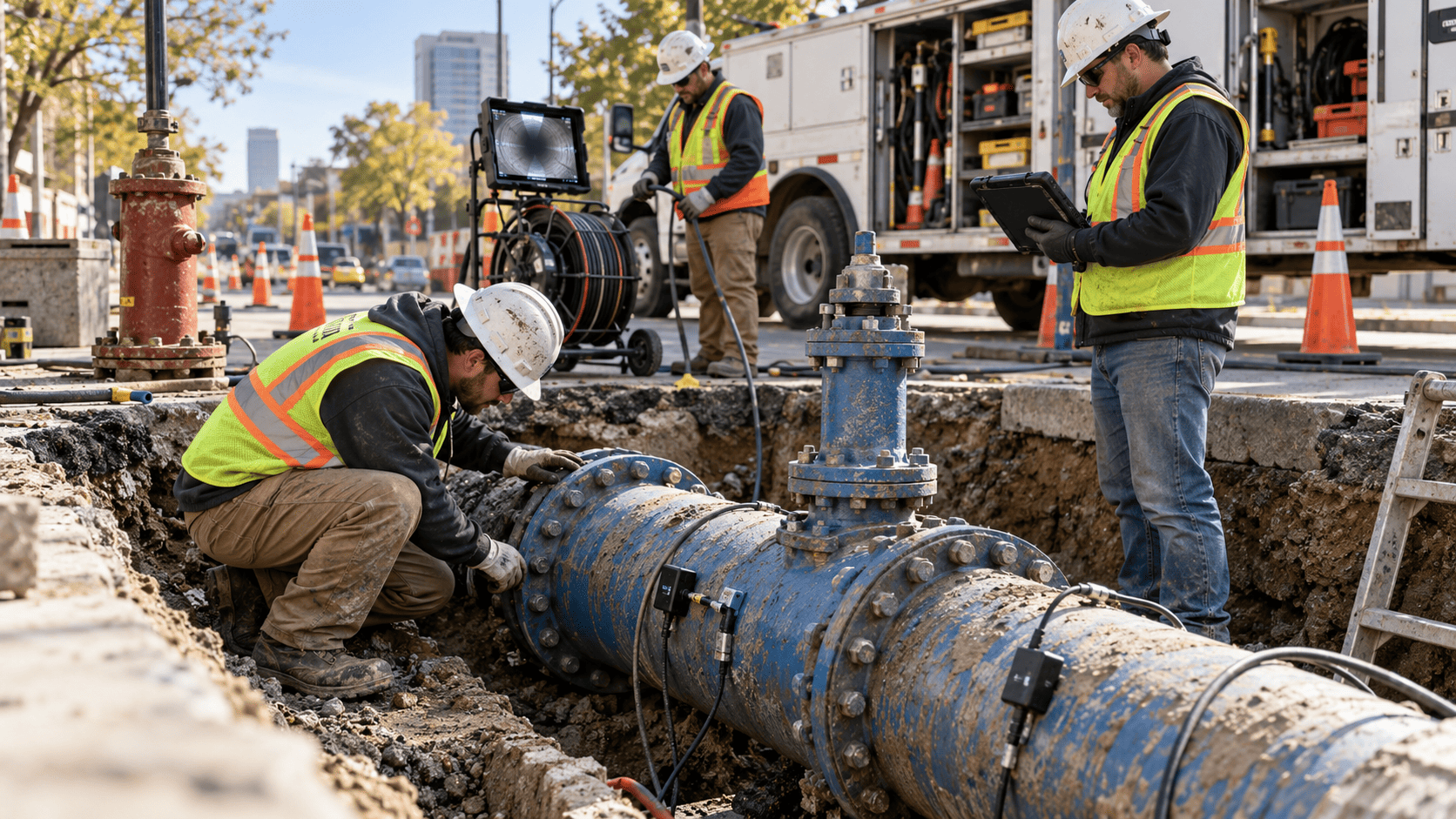
Municipalities rely on buried pipelines that may have been in service for decades, often with limited information about their actual internal condition. Age can indicate potential risk, but it does not tell a utility whether a specific pipe is close to failure, has years of useful service remaining, or needs targeted rehabilitation.
Municipal pipeline condition assessment combines system records, risk analysis, inspection data, and engineering interpretation to build a clearer picture of pipeline health. For pressure infrastructure such as drinking water mains, transmission mains, and wastewater force mains, that information can help utilities decide where to monitor, repair, rehabilitate, or replace assets.
A well planned assessment program is not simply about finding defects. The goal is to collect the right information to support better infrastructure decisions.
What Is Municipal Pipeline Condition Assessment?
Municipal pipeline condition assessment is the process of evaluating the physical condition and performance of a pipeline using available records, operating history, field inspection, testing, and condition data.
The process can range from a desktop review of break history and pipe characteristics to advanced pipeline inspection that evaluates wall condition, geometry, corrosion, leaks, or other potential defects.
Condition assessment should ultimately answer practical questions. Can the pipeline continue operating safely? Does a specific section require closer monitoring? Is localized repair enough, or should rehabilitation or replacement be planned?
Pipeline Inspection Vs. Condition Assessment
Pipeline inspection and condition assessment are closely related, but they are not the same process. Understanding the difference helps utilities choose the right scope for a project.
Pipeline Inspection Collects Condition Data
Inspection uses cameras, acoustic devices, inline tools, electromagnetic technologies, ultrasonic sensors, calipers, pressure monitoring, or other methods to gather information about the pipe.
An inspection may identify wall loss, leaks, deformation, internal deposits, corrosion, or other anomalies depending on the technology used.
Condition Assessment Turns Data Into Decisions
Condition assessment goes further by interpreting inspection findings alongside pipe material, installation history, operating conditions, previous failures, soil environment, and consequence of failure.
AWWA describes condition assessment as part of a broader risk based approach that helps utilities determine when assets should be maintained, repaired, rehabilitated, or replaced.
Why Municipalities Assess Pipeline Condition
Unexpected pressure pipe failures can result in service interruptions, emergency repairs, roadway damage, property impacts, environmental releases, and significant unplanned costs.
Condition assessment gives utilities a way to move from reactive maintenance toward more informed asset management.
The findings can help utilities:
Identify higher risk pipelines before failure
Prioritize inspection and maintenance budgets
Determine whether aging pipe can remain in service
Target specific sections for repair
Plan rehabilitation before deterioration becomes critical
Avoid replacing pipelines that still have useful service life
Support long term capital improvement planning
The value is not simply finding more defects. It is knowing which defects matter most and what action they justify.
Which Municipal Pipelines Should Be Assessed First?
Most utilities cannot perform high resolution inspection on every mile of pipe at once. A practical program starts by identifying pipelines where failure is both more likely and more consequential.
Evaluate Likelihood Of Failure
Factors associated with failure probability can include pipe age, material, break history, corrosion exposure, previous inspection findings, pressure conditions, installation history, and known deterioration mechanisms.
For wastewater systems, previous failures, pipeline profile, operating conditions, and corrosion exposure may help prioritize force main inspections.
Evaluate Consequence Of Failure
A pipe with moderate deterioration may deserve high priority if failure would affect a hospital, major roadway, water supply connection, environmentally sensitive area, or large number of customers.
Wastewater force mains may also carry significant environmental and regulatory consequences if a failure results in an uncontrolled sewage release.
Combining likelihood and consequence gives municipalities a more useful inspection priority than relying on pipe age alone.
What Information Should Be Reviewed Before Inspection?
The condition assessment process should begin before inspection equipment enters the pipeline. Existing information can help identify likely failure mechanisms and determine which inspection methods are worth deploying.
Utilities should review available GIS information, as built drawings, diameter, pipe material, installation year, repairs, break history, leak records, operating pressures, soil conditions, valve locations, and previous inspection results.
Accurate pipeline mapping can also help define alignment, elevation changes, access locations, and other physical characteristics that influence inspection planning.
Incomplete records are common in older municipal systems. They do not prevent inspection, but the uncertainty should be considered when selecting technology and planning field work.
Municipal Pipeline Condition Assessment Methods
There is no single inspection method that works equally well for every municipal pipeline. Technology should be selected according to the pipe material, expected deterioration mechanism, access, diameter, operating conditions, and the question the utility needs answered.
Desktop Condition Assessment
Desktop assessment uses existing information such as failure history, GIS records, material, age, pressure data, leak records, and soil conditions to rank pipeline risk.
It is relatively efficient and useful for prioritization, but it does not directly measure the internal or structural condition of the pipe.
CCTV And Visual Inspection
Cameras can identify visible deposits, cracks, joints, obstructions, lining problems, and other surface conditions.
CCTV is valuable in many applications, but visual inspection alone cannot reliably measure hidden wall loss or every form of structural deterioration in a pressure pipeline.
Acoustic Inspection
Acoustic technologies can help identify active leaks, trapped gas, unusual acoustic signatures, and other hydraulic anomalies.
These methods can provide useful screening information without requiring the same level of access as some high resolution inspection tools.
Ultrasonic Inspection
Ultrasonic technologies can measure pipe wall thickness and help characterize areas of material loss when the pipe and deployment conditions are suitable.
This can be particularly valuable when corrosion or wall thinning is a primary concern.
Electromagnetic And Magnetic Flux Leakage Inspection
Electromagnetic methods can evaluate certain metallic and concrete pressure pipes for deterioration that may not be visible from the surface.
Magnetic flux leakage can be used in suitable metallic pipelines to identify areas associated with metal loss. AWWA identifies ultrasonics, magnetic flux leakage, and electromagnetic technologies among the high resolution inspection approaches available for pressure pipes.
Caliper And Geometry Inspection
Caliper tools measure the internal geometry of a pipeline and can identify changes such as dents, ovality, deformation, or restrictions.
These findings can also help determine whether a pipeline is suitable for more advanced inline inspection.
Smart Pigging And Inline Inspection
Modern smart pigging can collect detailed information while traveling through compatible pipelines. Depending on the technology, inline inspection can evaluate wall condition, geometry, corrosion, and other integrity indicators.
The pipeline must first be evaluated for diameter changes, bends, valves, access points, restrictions, and other features that could affect tool passage.
How Pipe Material Changes The Assessment Strategy
Inspection technology should never be selected without considering pipe material. A method that performs well on one pipeline may provide little useful information on another.
Cast iron and ductile iron systems may require evaluation for corrosion, pitting, graphitization, tuberculation, and wall loss. Steel pipelines may require attention to internal and external corrosion, wall thinning, coating condition, and geometry.
Concrete pressure pipe has different deterioration mechanisms, including prestressing wire or bar deterioration. PVC and HDPE systems also require methods suited to nonmetallic pipe behavior.
AWWA specifically separates pressure pipe assessment according to material and recognizes that metallic, concrete, PVC, HDPE, and other pipe types may require different inspection approaches.
The Municipal Pipeline Condition Assessment Process
A successful assessment project should begin with the decision the utility needs to make rather than with a preferred inspection tool.
Step 1: Define The Objective
Determine whether the project needs to locate leaks, measure wall loss, identify restrictions, assess corrosion, evaluate geometry, estimate remaining service life, or support a repair or replacement decision.
Clear objectives prevent unnecessary inspection work and help determine the required level of data.
Step 2: Review Pipeline History And Risk
Gather available records and rank assets according to likelihood and consequence of failure.
Lower effort screening may be sufficient for some pipelines, while critical assets may justify more detailed inspection.
Step 3: Select The Inspection Method
Match the technology to the pipeline material, diameter, access, operating status, suspected deterioration mechanism, and required resolution.
A utility may use several methods rather than expecting one technology to answer every condition question.
Step 4: Prepare The Pipeline
Some inline technologies require cleaning, gauging, access modifications, flow planning, or confirmation that the pipeline is piggable.
Removing deposits and restrictions through appropriate pipeline cleaning can improve tool passage and, for some technologies, improve the quality of the data collected.
Step 5: Perform And Track The Inspection
During field inspection, teams monitor tool movement, operating conditions, inspection coverage, and data quality.
Tool position must be correlated accurately with pipeline location so identified anomalies can be found again for verification, repair, or future monitoring.
Step 6: Analyze The Findings
Raw inspection signals are converted into useful information about the location, type, extent, and severity of identified conditions.
The findings should also be considered alongside pipeline history and operating environment rather than interpreted in isolation.
Step 7: Build An Action Plan
Inspection results may support several outcomes. A healthy pipeline may remain in operation, while another may need more frequent monitoring, cleaning, localized repair, rehabilitation, or replacement.
The objective is to direct resources toward the areas where intervention provides the greatest operational and financial value.
Can Municipal Pipelines Be Inspected While In Service?
Some technologies can assess pipelines while they remain pressurized or operating, while others require shutdown, isolation, drainage, or flow changes.
The best option depends on the inspection technology, pipe configuration, access, service requirements, and acceptable level of operational disruption.
For critical mains with limited redundancy, the ability to inspect with minimal interruption may heavily influence technology selection.
Does A Pipeline Need To Be Cleaned Before Inspection?
Not every inspection requires the same level of cleaning. However, heavy tuberculation, sediment, scale, debris, or other buildup can interfere with tool passage or reduce the effectiveness of certain inspection technologies.
Cleaning and gauging can therefore form an important part of inspection preparation, particularly for inline tools. The required condition should be established according to the selected inspection method rather than applying the same cleaning standard to every pipeline.
What Should A Condition Assessment Report Provide?
A useful report should translate inspection data into information that a utility can act on.
Depending on the project, it may include pipeline identification, inspection coverage, identified anomalies, defect locations, condition severity, data limitations, risk priorities, and recommendations for monitoring or intervention.
When assessment findings indicate potential integrity concerns, additional pipeline integrity testing may help utilities verify performance or investigate specific areas before making larger rehabilitation decisions.
How American Pipeline Solutions Supports Municipal Condition Assessment
American Pipeline Solutions supports municipalities through pipeline cleaning, inspection preparation, inline inspection, condition analysis, mapping, leak detection, pigging, and integrity services.
APS works with water mains and wastewater force mains to select practical methods based on the pipeline, operating conditions, suspected problems, and information the utility needs from the project. Inspection technologies may include smart pigs, caliper tools, electromagnetic methods, ultrasonic technologies, cameras, acoustic tools, and other appropriate approaches.
The goal is not to apply the most complex inspection technology to every asset. It is to help pipeline owners collect useful condition information and turn it into better maintenance and capital planning decisions.
Frequently Asked Questions
What Is Municipal Pipeline Condition Assessment?
It is the process of evaluating pipeline condition using asset records, risk information, inspection technologies, testing, and analysis. The results help utilities make maintenance, monitoring, repair, rehabilitation, and replacement decisions.
What Is The Difference Between Inspection And Condition Assessment?
Inspection collects information about the physical pipeline. Condition assessment interprets that information alongside history, risk, operating conditions, and other factors to determine what action should follow.
Is CCTV Enough For Pressure Pipe Condition Assessment?
Not always. CCTV can identify visible internal conditions but generally cannot characterize every form of wall loss, corrosion, or hidden structural deterioration. Other technologies may be required depending on the inspection objective.
How Do Utilities Decide Which Pipelines To Inspect First?
Utilities commonly consider both likelihood of failure and consequence of failure. Critical pipelines with concerning condition indicators or significant consequences deserve greater assessment priority.
Can Condition Assessment Estimate Remaining Pipeline Life?
Detailed inspection and engineering analysis may help estimate remaining useful life for some pipeline materials and deterioration mechanisms. The reliability of the estimate depends on the available data, inspection technology, and understanding of how deterioration is progressing.
How Often Should Municipal Pipelines Be Assessed?
There is no single interval that applies to every pipeline. Inspection frequency should reflect pipeline condition, criticality, previous findings, material, operating environment, deterioration rate, and consequence of failure.
Make Pipeline Decisions Based On Condition, Not Age Alone
An older municipal pipeline is not automatically a failed pipeline, and a newer pipeline is not automatically free of risk. Reliable condition data gives utilities a stronger basis for deciding where limited maintenance and capital budgets should be invested.
A structured condition assessment program can identify higher risk assets, select appropriate inspection methods, reveal deterioration, and support targeted monitoring, repair, rehabilitation, or replacement. American Pipeline Solutions helps municipalities develop that clearer understanding of their pressure pipelines so infrastructure decisions can be based on actual condition rather than assumptions.


