
No-Des Process vs. Ice Pigging™: Real Results Compared

For years, many private water companies and municipalities have debated whether a No-Des process or Ice Pigging™ is the best pipe cleaning solution. Both of these water main flushing procedures have their advantages and disadvantages, but it's evident that one method is better than the other.
If you're a private water company or a municipality representative considering these two methods, you’ve come to the right place. In this article, we're going to discuss everything you need to know about these pipe cleaning processes to determine which is the best solution for your pipeline cleaning needs.
To help you decide, we have not only spoken about their differences. We have also outlined why Ice Pigging™, the process offered by American Pipeline Solutions, is the better pipeline cleaning procedure by citing real results comparing these water main flushing procedures.
Pipeline Experts: Inspection, Cleaning, Coating & More
Certified solutions for inspection, pre-commissioning, cleaning, internal coating, ice pigging™, mapping, and turnkey pipeline projects—maximizing safety and reliability at every stage.
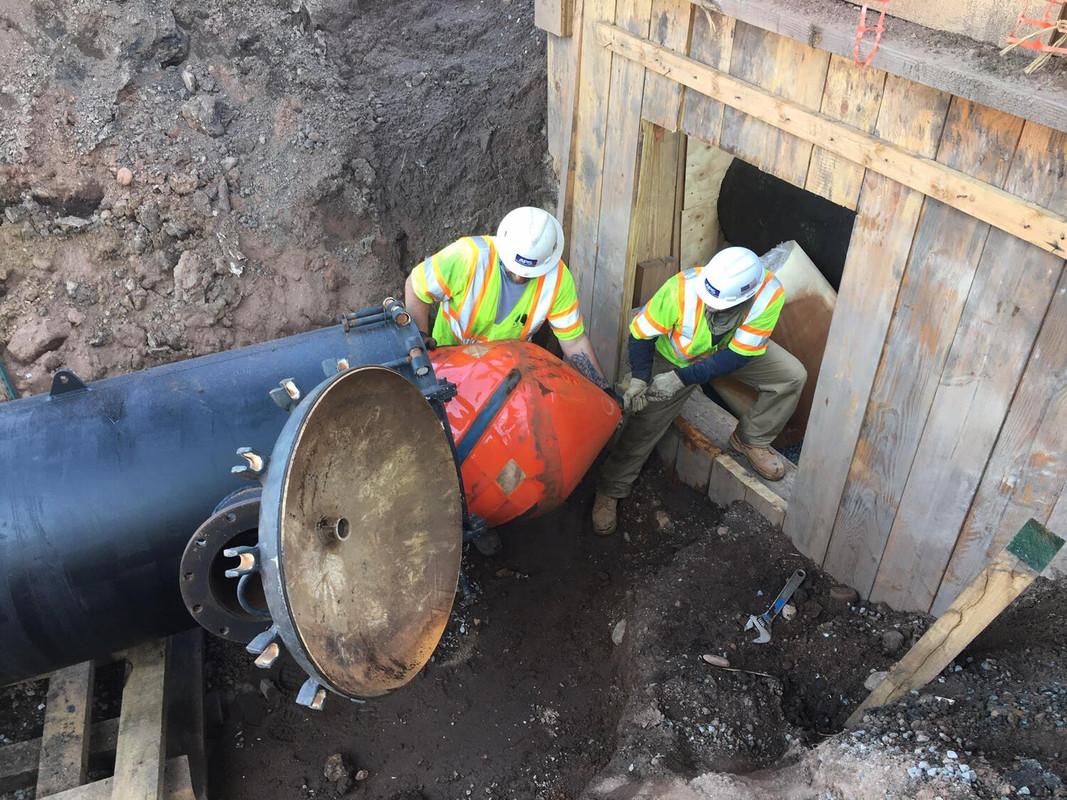
Water Main Flushing Procedures: No-Des vs. Ice Pigging™
Below, we will compare No-Des vs. Ice Pigging™ so you can decide which is the best option for your project.
No-Des Flushing
Discharge Elimination System (No-Des) is a pipeline flushing method that was developed in the United States to clean pipelines. This pipeline cleaning method is one of the most eco-friendly methods (like Ice Pigging™) that has been created in recent years.
Unlike traditional flushing, methods No-Des allows for minimal water wastage. Additionally, this pipeline cleaning process is effective at removing sediments but not as effective as Ice Pigging™.
Interestingly, the No-Des process is very different from Ice Pigging™. It is also different from traditional pipeline flushing methods involving letting water discharge onto a street after being flushed by opening fire hydrants.
This technology involves pumping water at an incredibly high speed around a section of a water supply network that has been closed off to remove sediment. To do this, a temporary above-ground loop is created by attaching a hose to two fire hydrants.
This water is also pumped through filters that are mounted on the back of a utility truck. Additionally, the No-Des truck that pumps water also adds chlorine to it to ensure a safe level of disinfection is maintained during the pipeline cleaning process.
Ice Pigging™
Ice Pigging™ is a more popular method of cleaning pipelines than No-Des. Although Ice Pigging™ may waste a little more water than No-Des, this method still typically uses 50% less water than traditional flushing methods.
Additionally, Ice Pigging™ is far more effective at removing sediment from pipelines, especially when compared to the No-Des process. This is simply because of the fact that the ice pig offers up to 1,000 x more shear on the inside of the pipe wall. It is also more cost-effective for water companies and municipalities.
With Ice Pigging™, the process is more involved than No-Des, which is another reason why it's more effective at removing sediment. This process utilizes a unique ice slurry mixture known as an "ice pig."
Before an ice pig can be pushed into a pipeline to remove sediment, a pipeline water main must be isolated. Once a section of the main has been isolated, a specialist technician will pump the ice slurry into the pipeline via hoses.
After the slurry (ice pig) has been pumped and while it's being monitored, an upstream valve will be opened to create pressure that will allow the ice pig to move through the pipeline and remove the sediment in its way.
Once the ice pig has made its way to the exit point, it will be discharged into a local sanitary sewer or picked up and deposited into a tanker before it is carefully disposed of safely so as to be no harm to the environment. Ice Pigging™ is often safer than No-Des as it is adaptable to pipe topology and provides a reduced risk of pipeline damage.
Is No-Des or Ice Pigging™ More Expensive?
One of the most significant questions many ask is if the No-Des process of pipeline cleaning is more or less expensive than Ice Pigging™. This question is complex because which process is more expensive will depend on the factors surrounding the pipeline cleaning that needs to be undertaken.
According to experts, the No-Des process will pay for itself over time, which means it has a higher initial cost than Ice Pigging™ for municipalities. So although No-Des is cost-effective, this is a long-term benefit that isn't immediate. However, you should note that the No-Des flushing system has been proven to cost approximately 50% less than unidirectional flushing.
In contrast, many believe Ice Pigging™ to be one of the most cost-efficient pipeline cleaning methods available at present –– even more so than the No-Des process. For example, in 2012, at an AWWA distribution system webinar, Ice Pigging™ was estimated to cost between $1.70 and $5.50 per linear foot. On the other hand, traditional pigging was estimated to cost between $16.10 and $21.00 per linear foot, swabbing between $5.70 and $9.10 per linear foot.
No-Des vs. Ice Pigging™ Real Results Compared: Which Is Better?
It's no secret that the No-Des process has a few benefits, but in many situations, Ice Pigging™ is the better pipe cleaning method. When a real-world comparison was performed, the results revealed that Ice Pigging™ is a better pipeline cleaning solution in many areas. We have discussed the results of this comparison below.
Ice Pigging™ is a cross between flushing and pigging, while the No-Des process is a strictly flushing method using an in-line pipe, making Ice Pigging™ preferable.
The No-Des process has less water usage at up to 1 times the pipe volume, whereas Ice Pigging™ has a water usage volume of 1.25 times the pipe volume. Yet unlike the No-Des method; there is no leaking with Ice Pigging™.
It's been proven that the No-Des method has less daily coverage than Ice Pigging™. The No-Des method has daily coverage of up to approximately 1.24 miles per day, while Ice Pigging™ can impressively cover up to 3 miles of pipe cleaning per day.
Unlike Ice Pigging™ which has a pipe range of between 1 to 42 inches, the No-Des process can only clean pipes that are below 12 inches in size.
In most instances, a water supply will only be interrupted for between 1 to 4 hours during an Ice Pigging™ procedure. In contrast, the No-Des method could require a pipeline interruption for an entire day. Ice Pigging™ also has no other interruptions to its process, while the No-Des process could cause driveway and traffic interruptions.
One of the biggest benefits of Ice Pigging™ is that there is a very low chance of resuspension of sediments, while the No-Des process has a medium to high chance.
Unlike the No-Des method, which can only be utilized for water pipelines, Ice Pigging™ has water plus sewer force mains and siphon applications.
Pipeline Experts: Inspection, Cleaning, Coating & More
Certified solutions for inspection, pre-commissioning, cleaning, internal coating, ice pigging™, mapping, and turnkey pipeline projects—maximizing safety and reliability at every stage.
Speak With An Expert At American Pipeline Solutions About Our Ice Pigging™ Process
It's evident that Ice Pigging™ is the better pipeline solution when compared to the No-Des process. Ice Pigging™ is an attractive option for many with more applications and benefits. If you would like to learn more about Ice Pigging™ and why it's the perfect pipeline cleaning solution for your project, you can speak to one of the experts at American Pipeline Solutions. Contact us and we will gladly answer any questions you may have.
FAQs: No-Des Process vs. Ice Pigging™
What is No-Des flushing and how does it work?
No-Des (Discharge Elimination System) is a pipeline flushing method that circulates water at high velocity through a closed section of the water network. The water is pumped through filters mounted on a truck, with chlorine added to maintain disinfection. This process removes sediment with minimal water discharged to waste, making it more eco-friendly than traditional hydrant flushing.
What is Ice Pigging™ and how does it work?
Ice Pigging™ uses a thick ice slurry (“ice pig”) to clean pipelines. After isolating a section of main, a specialist pumps the slurry into the pipe and uses upstream pressure to push it through. The ice pig conforms to the pipe, applies very high shear to the wall, and scrapes out sediment as it travels. The slurry is then discharged and safely disposed of, often via sanitary sewer or tanker.
Which method removes more sediment: No-Des or Ice Pigging™?
Both methods outperform traditional flushing, but Ice Pigging™ is generally more effective at removing sediment. Because the ice pig applies up to 1,000 times more shear on the pipe wall than conventional flushing, it can dislodge and carry out deposits that No-Des may leave behind. In real-world comparisons, Ice Pigging™ has shown better cleaning performance and lower risk of resuspending sediment.
Which process uses more water: No-Des or Ice Pigging™?
No-Des typically uses less water, with usage around one pipe volume. Ice Pigging™ usually operates at about 1.25 times the pipe volume, so it uses slightly more water than No-Des. However, Ice Pigging™ still uses significantly less water than traditional unidirectional flushing and can deliver better cleaning results, which often offsets the marginal increase in water use.
Is Ice Pigging™ more expensive than No-Des?
Cost depends on project scope, pipe size, and network layout, but Ice Pigging™ is often considered one of the most cost-efficient advanced cleaning methods available. Industry estimates have placed Ice Pigging™ in the range of roughly $1.70–$5.50 per linear foot, compared with much higher costs for traditional pigging and higher long-term setup costs for some No-Des systems. For many utilities, Ice Pigging™ offers strong value for performance.
How much pipeline can Ice Pigging™ and No-Des clean per day?
Ice Pigging™ has been shown to clean up to about 3 miles of pipe per day under suitable conditions. The No-Des process typically achieves lower daily coverage, around 1.24 miles per day. For utilities and municipalities looking to maximize cleaning progress within limited shutdown windows, this higher daily coverage is a key advantage of Ice Pigging™.
What pipe sizes can each method handle?
No-Des systems are generally limited to smaller diameters, typically below 12 inches. Ice Pigging™, by contrast, can be used on a much wider range of pipe sizes, from approximately 1 inch up to 42 inches. This makes Ice Pigging™ more suitable for mixed networks or larger transmission and trunk mains where diameter varies across the system.
How do No-Des and Ice Pigging™ impact customer service interruptions?
Ice Pigging™ usually requires shorter interruption windows—often around 1 to 4 hours for the affected area—before normal service is restored. No-Des cleaning can require a longer disruption, sometimes lasting most of the day, and may also introduce traffic or driveway interruptions around the flushing setup. For customer impact and scheduling, Ice Pigging™ tends to be more flexible.
Which method has a higher risk of resuspending sediment?
Ice Pigging™ is designed to carry sediment out of the pipeline in a controlled way, and it has a very low chance of re-suspending material once cleaning is complete. The No-Des process, while effective, has a medium to high risk of resuspension, meaning loosened particles can be stirred back into the water if conditions are not ideal.
Where can Ice Pigging™ be used compared to No-Des?
No-Des is mainly limited to potable water pipelines. Ice Pigging™ has a broader range of applications, including water mains, sewer force mains, and siphons. This flexibility makes Ice Pigging™ a strong choice for utilities and municipalities managing mixed networks or complex system layouts.


